Examples and Case Studies of Climate-SRHR MEL
Case Study 02:
Integrating SRHR into a HNAP

Introduction
Integrating SRHR into national climate policies is a critical step for ensuring that these issues are prioritized and financed; alignment with national policies is often a prerequisite for accessing global climate financing mechanisms. When one grassroots advocacy organization realized that their country would be updating their Health National Adaptation Plan (HNAP), they set out to make sure that SRHR was included in the revised document. The initial HNAP included only a brief reference to pregnant women as “especially vulnerable to climate change.”
Developing the project concept and theory of change
The team wants to focus on climate change and SRHR broadly. However, they know that cyclones and sea level rise are a major concern in their country. Within this project, their role will be to support the ongoing policy process, so they want to keep their scope of work focused. Their initial theory of change focused on engaging stakeholders and developing advocacy materials:
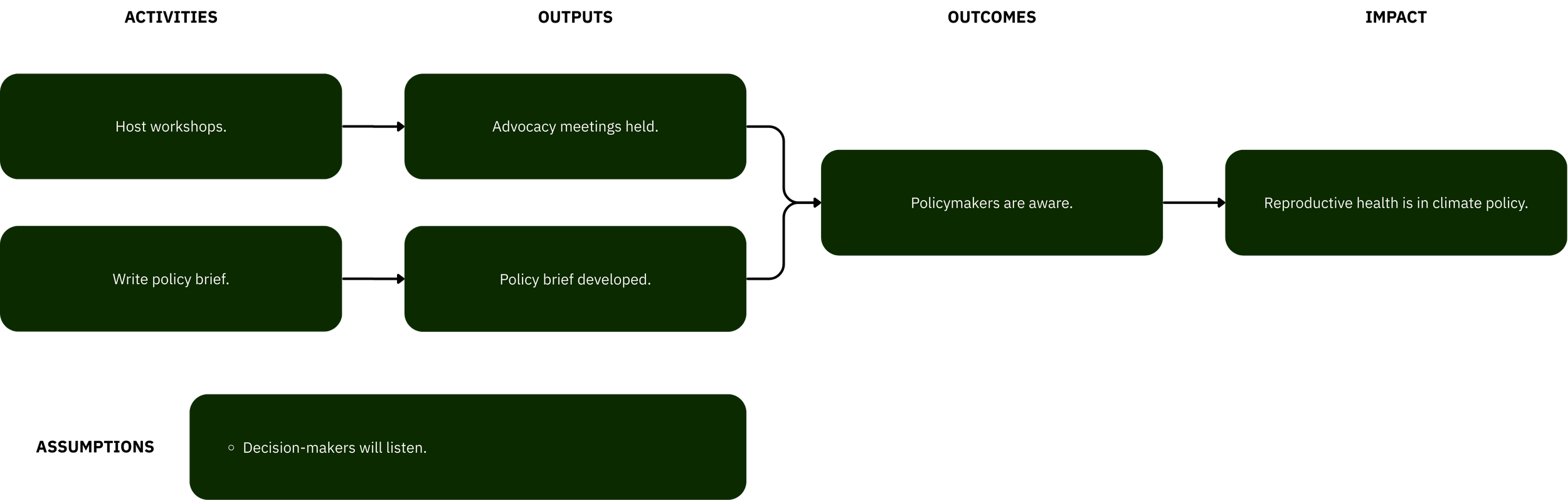
They shared this plan with a staff member at a funding organization that they have a good relationship with. The staff member was concerned about the logic behind the theory of change: they did not think that the activities listed would be sufficient to achieve the project’s aim. They noted some inconsistencies in the concept, as well as some areas where the information provided was not specific enough:
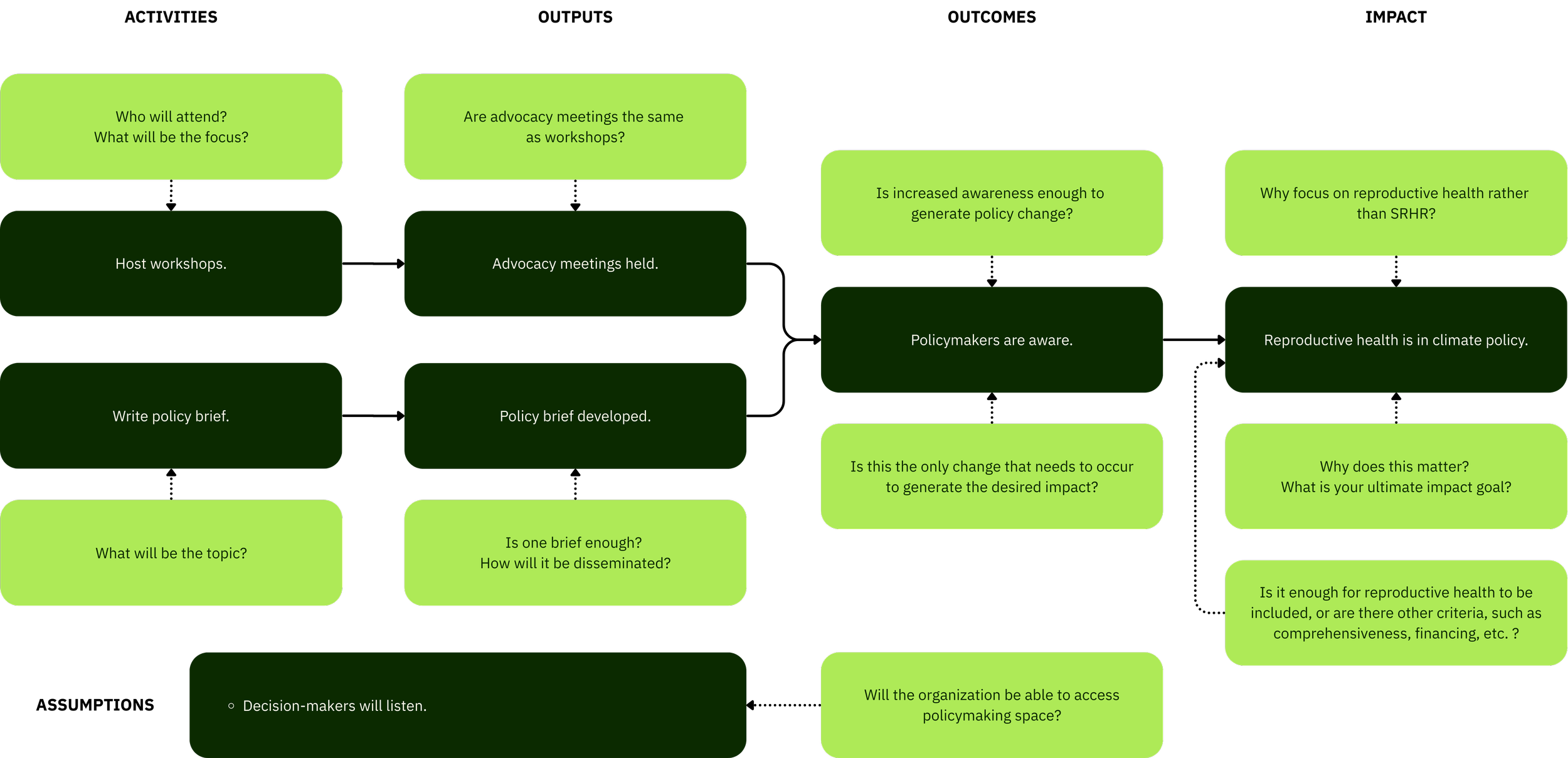
Based on the feedback they received, the team spoke with several stakeholders who participated in the initial HNAP development process. These individuals told them that SRHR was not included in the first HNAP because policymakers had not considered climate risks to SRHR, and organizations working on climate and SRHR had not contributed to the policymaking process. Ultimately, since SRHR is not included in national climate adaptation policy, climate-SRHR projects struggle to access financing, and SRHR is often left behind during climate emergencies, leaving community members vulnerable to worsening SRHR outcomes.
Based on this evidence, they determine that if climate-related SRHR risks and interventions are prioritized and financed in national policy, SRHR outcomes will be strengthened, even in the face of climate change. Their project will focus specifically on the HNAP, rather than the entire climate adaptation policy space. Therefore, within their project, they determine that if policymakers and advocates have a better understanding of climate-SRHR risks and policy needs, and if climate-SRHR priorities are better represented in the HNAP revision process, then comprehensive SRHR priorities will be included and financed in the revised HNAP.
They decide on a project with two objectives:
Strengthen policymakers’ and advocates’ understanding of climate-SRHR risks and policy needs
Ensure climate-SRHR priorities are represented in the HNAP revision process
Their target population includes policymakers, technical inputters, policy reviewers, advocates, and other stakeholders engaged in the HNAP revision process.
Their key interventions include:
Conducting a gender-responsive landscape assessment of HNAP stakeholders and windows for policy development
Developing locally-grounded evidence briefs on key climate-SRHR issues, tailored to national priorities
Facilitating multi-sectoral technical and advocacy round tables to share evidence and build consensus around climate-SRHR action points and priorities
Providing technical input into HNAP drafting through content proposals and technical review
As the team refined their theory of change, decided to include both intermediate outcomes and an end outcome, since the process of creating policy change can be slow, and is outside the scope of any single organization’s control:
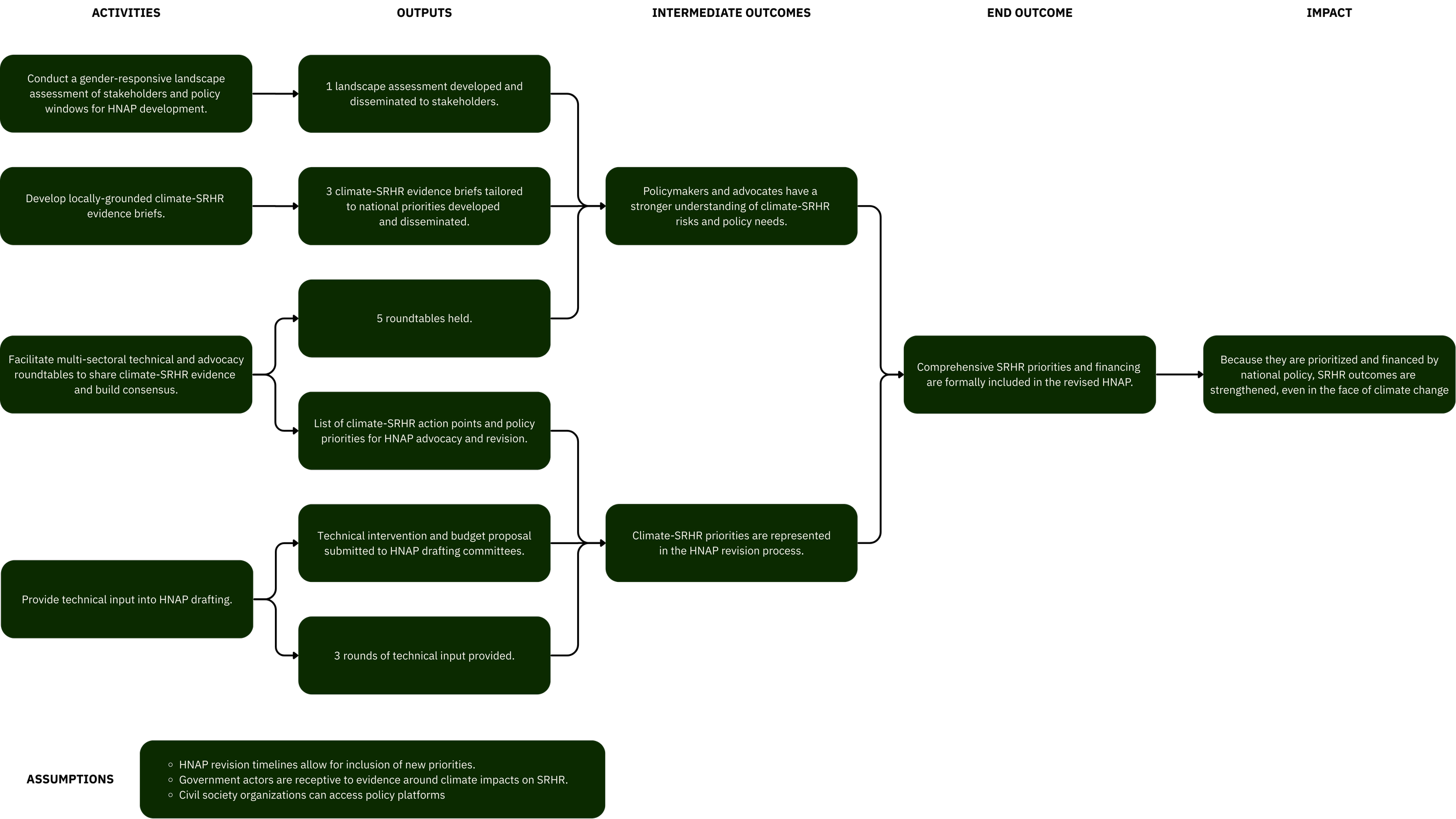
Remember, this is one project! Other projects might include different activities, such as community co-design workshops, a policy analysis of other climate-SRHR policies (globally, nationally, or sub-nationally), financing workshops, vulnerability and adaptation assessments, health facility assessments, establishing a formal advocacy coalition, etc.

Now that they have a clear sense of their project’s activities and objectives, they’re ready to begin choosing indicators.

Using the MEL framework to select indicators
To select their indicators, the team reviewed the climate-SRHR indicator set to identify output, outcome, and impact indicators that aligned with their project’s activities. In some cases, they adapted the indicator slightly to reflect their specific program needs. For example, they made indicators more specific to reflect their particular activities and participants.
Intermediate Outcome 1: Policymakers and advocates have a stronger understanding of climate-SRHR risks and policy needs.
The first intermediate outcome that this project aims to achieve is for policymakers and advocates to have a stronger understanding of climate-SRHR risks and policy needs. This falls under Indicator 18: Diverse stakeholders are engaged in efforts to formalize and finance climate-SRHR policy. For this project, this means they will be looking at how many policymakers and advocates have increased knowledge about climate change and SRHR as a result of their participation in project activities.
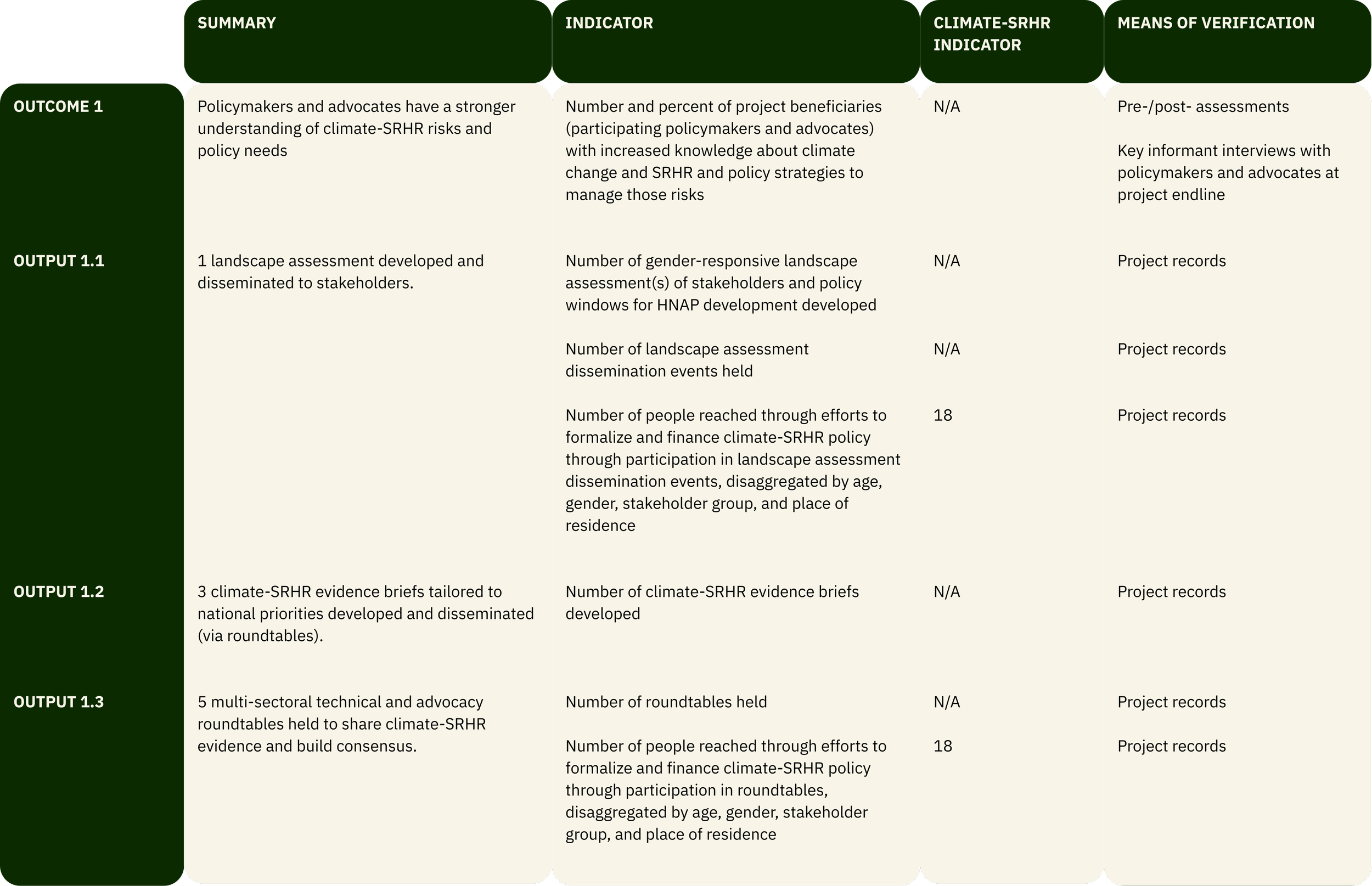
Intermediate Outcome 2: Climate-SRHR priorities are represented in the HNAP process.
The second intermediate outcome that this project aims to achieve is for climate-SRHR priorities to be represented in the HNAP process. This falls under Indicator 16: National climate adaptation policies include SRHR. For this project, Indicator 16 is an end outcome indicator, so to assess this intermediate outcome, the team will be using qualitative measures.
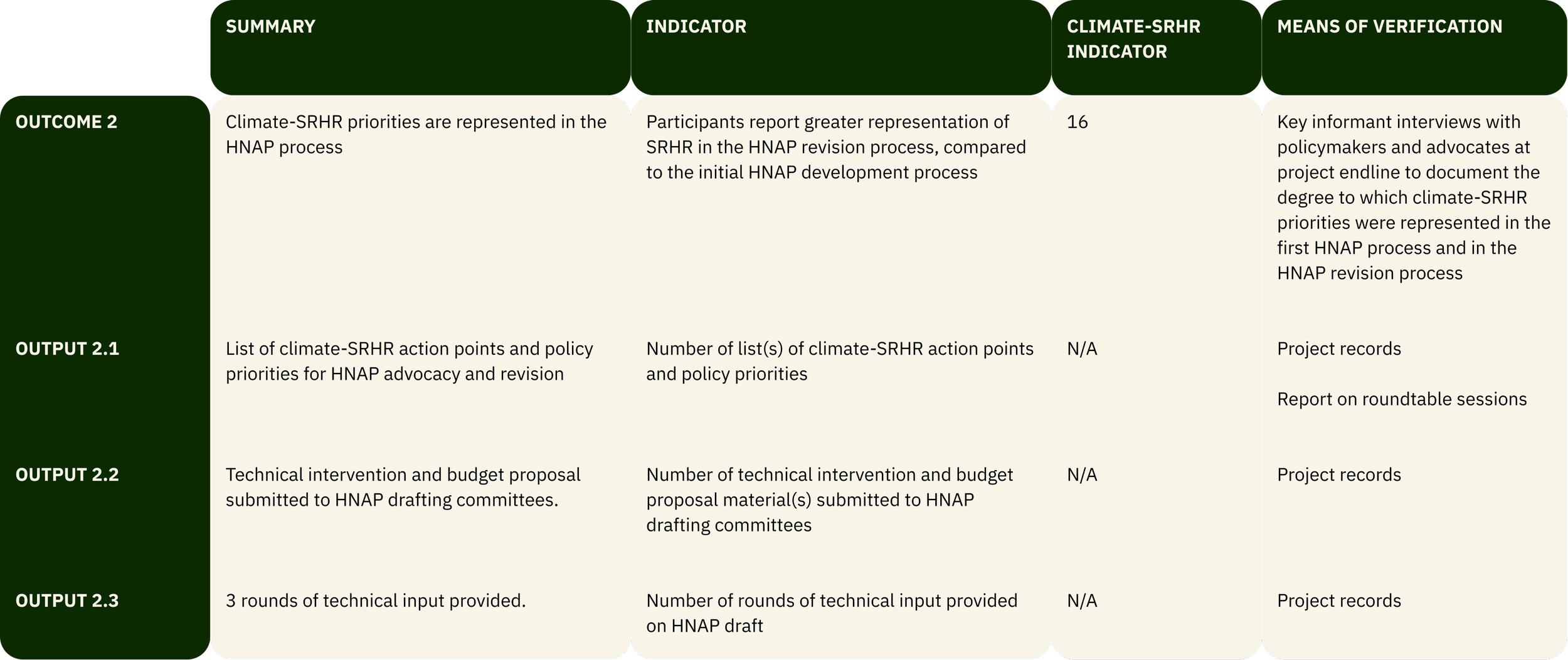
End Outcome: Comprehensive SRHR priorities and financing are formally included in the revised HNAP.
The end outcome that this project aims to achieve is for comprehensive SRHR priorities and financing to be included in the revised HNAP. This falls under Indicator 16: National climate adaptation policies include SRHR. For this project, this means that the project will report whether the HNAP policy was updated to include SRHR, as well as conduct an endline policy analysis to identify what type of SRHR was included in the final updated policy.
Because this funder is specifically interested in understanding the climate-SRHR policy process, they advised the team to ensure that the project lasted a minimum of six months past the anticipated revised HNAP release date, giving them time to conduct endline interviews with participants, document the policy process, and conduct a policy analysis of the final HNAP document.
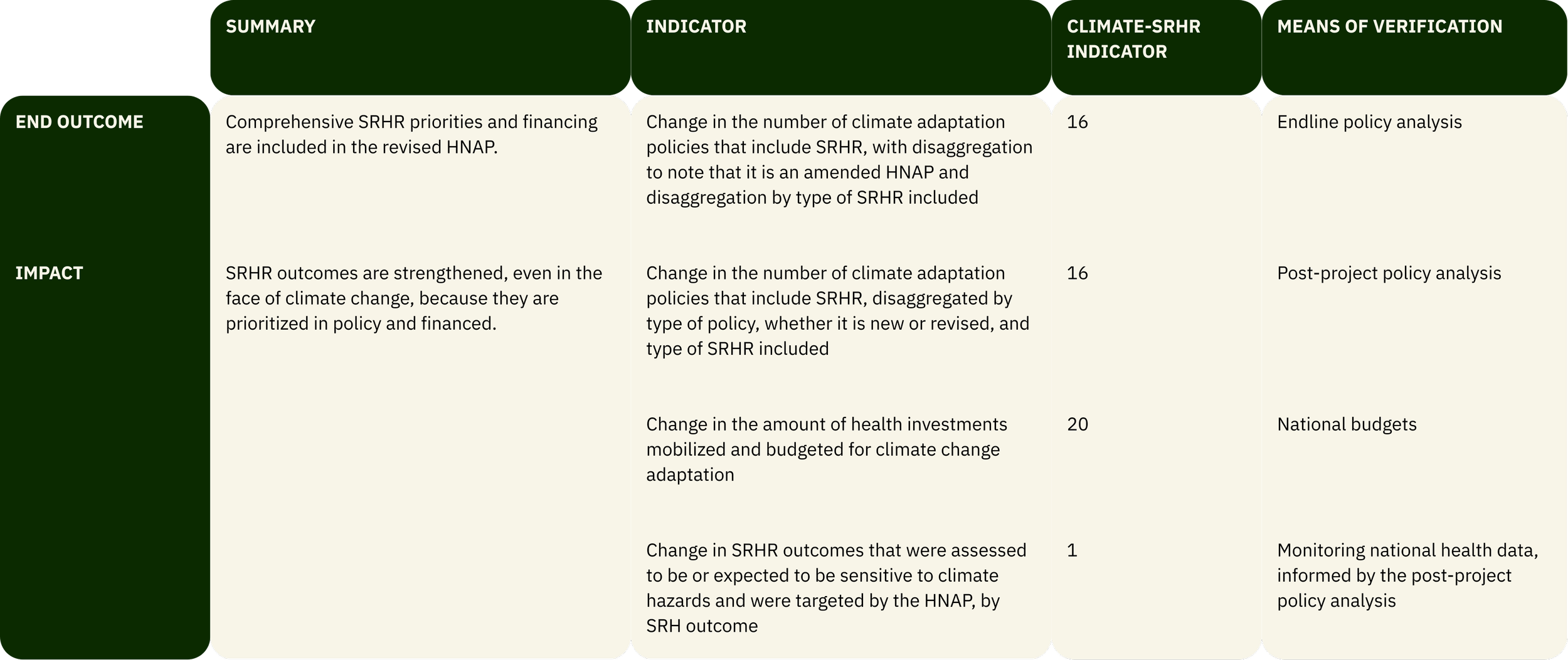
The project’s overall impact goal is for SRHR outcomes to be strengthened, even in the face of climate change, because they are prioritized in policy and financed, SRHR outcomes are strengthened, even in the face of climate change. This also falls under Indicator 16: National climate adaptation policies include SRHR - measured by looking at all of the country’s climate policies - Indicator 20: Financing is mobilized for climate-SRHR action, and Indicator 1: Climate-SRHR projects contribute to improved SRHR outcomes. However, these indicators are not likely to demonstrate significant change during the project period. As such, they could be monitored either by the funder as part of their overall portfolio impact monitoring process, by the implementing organization on an ad hoc basis, or by a third-party organization receiving support for monitoring investment and policy change (e.g., to reduce duplication of efforts across multiple organizations in the same region).
Implementing the MEL plan
This project team doesn’t have a MEL officer. Instead, they have hired a program manager who has experience with managing project records, as well as qualitative data collection. The program manager will work closely with a technical advisor to manage program data, track progress, and develop reports to the donor. Their MEL plan involves:
Team check-ins each month to coordinate advocacy action and track progress
After action reviews (learning sessions) with project staff and key partners after each advocacy deliverable or event is completed
A report with participant information, information shared, and lessons learned after each advocacy deliverable or event is completed
Annual report to the donor
Project results and lessons learned shared with participating advocates, policymakers, and the global community via a webinar

Learn from Others
This is a fictional case study, but across the globe, organizations are taking action to integrate SRHR into climate policy:
Panorama Global - featured in one of our Climate-SRHR Evidence Hub Case Studies - funds advocacy organizations working at the intersection of climate change and SRHR. For example, they supported Climate Action Network (CAN) Tanzania’s work to integrate SRHR into Tanzania’s revised HNAP. As part of those efforts, CAN Tanzania conducted research on perceived impacts of climate change on reproductive, maternal, and child health outcomes in Tanzania.
YLabs’report Sexual and Reproductive Health and Rights in National Adaptation Plans and Health National Adaptation Plans provides an analysis of how SRHR is discussed in climate plans across the world, and can serve as a framework for conducting policy analyses.