
SRHR, Climate Change, and MEL 101
Climate change is increasingly affecting every aspect of life - and that includes SRHR:
Climate change affects SRHR service delivery and outcomes - and influences individuals’ needs and preferences.
Advancing SRHR is central to building resilience to climate change, because gender equity and health are critical for reducing vulnerability to climate change and increasing the effectiveness of climate adaptation efforts.
-
Climate change poses a serious risk to a range of SRHR outcomes, threatening hard-won gains in contraceptive access, maternal health, and gender based violence prevention and response.
Left unaddressed, these risks may severely affect the well-being and autonomy of women and girls worldwide.
These risks occur as a result of direct exposure to climate hazards, indirect socioeconomic effects of those hazards, and systems-level impact on health facilities, infrastructure, and policies.
-
Health - including sexual and reproductive health - is in and of itself is an important component of climate resilience: when individuals are healthier, they are better able to cope with climate-related hazards and are less vulnerable to these hazards.
At the same time, improvements to health can also have co-benefits for other aspects of climate resilience, including increased income, reduced expenditures, and increased time. When delivered in an inclusive and equitable manner, activities that yield improvements in health can also help to reduce inequities based on gender, age, disability, and other social categories, which can increase vulnerability to climate change.
SRHR is for people of all genders, but gender biases are major drivers of gaps in SRH service availability and quality. By addressing persistent gender inequities and improving the health and well-being of women and girls, SRHR programming can also increase the social participation, leadership skills, and community engagement of women and girls. Climate action is more effective when more women and girls are engaged - for example, higher representation of women in government is associated with lower carbon emissions, and greater gender equality is associated with greater vulnerability to climate change.
Efforts to improve other domains of climate resilience can also have co-benefits for SRHR. For example, efforts to promote inclusive preparedness planning, sustainable livelihoods, and robust infrastructure can ensure that SRH services and commodities are accessible before, during, and after climate emergencies, enabling people of all genders to be healthy and have autonomy over their own bodies even amid a changing climate.

Understanding Climate Resilience
In this guide, we focus on several different domains of climate resilience, including:
Health and health services (including SRHR)
Exposure to climate extremes
Preparedness and planning
Awareness and skills for adaptive behaviors
Poverty reduction and sustainable livelihoods
Bodily autonomy
Food security
Infrastructure and energy
Social services and social protection
Natural resource management
Leadership and equity
Policy
This list is not exhaustive: we encourage you to explore what climate resilience means to your organization's staff, the organizations you partner with, and the beneficiaries of investments and projects that you support.
When taking action to strengthen resilience to climate change, it’s important to remember that climate resilience is not a static end state to be achieved. Rather, it is:
Subjective: Each individual, community, or system will have their own beliefs and expectations around what being climate resilient means to them- and their own needs with respect to how to they can become more resilient
Dynamic: Climate resilience can and does shift over time in response to changing hazards, needs, knowledge, and experiences
Multi-sectoral: Climate hazards can affect every aspect of life; therefore, increasing capacity to successfully navigate these hazards requires paying attention to the intersection of multiple areas of vulnerability, exposure, and response
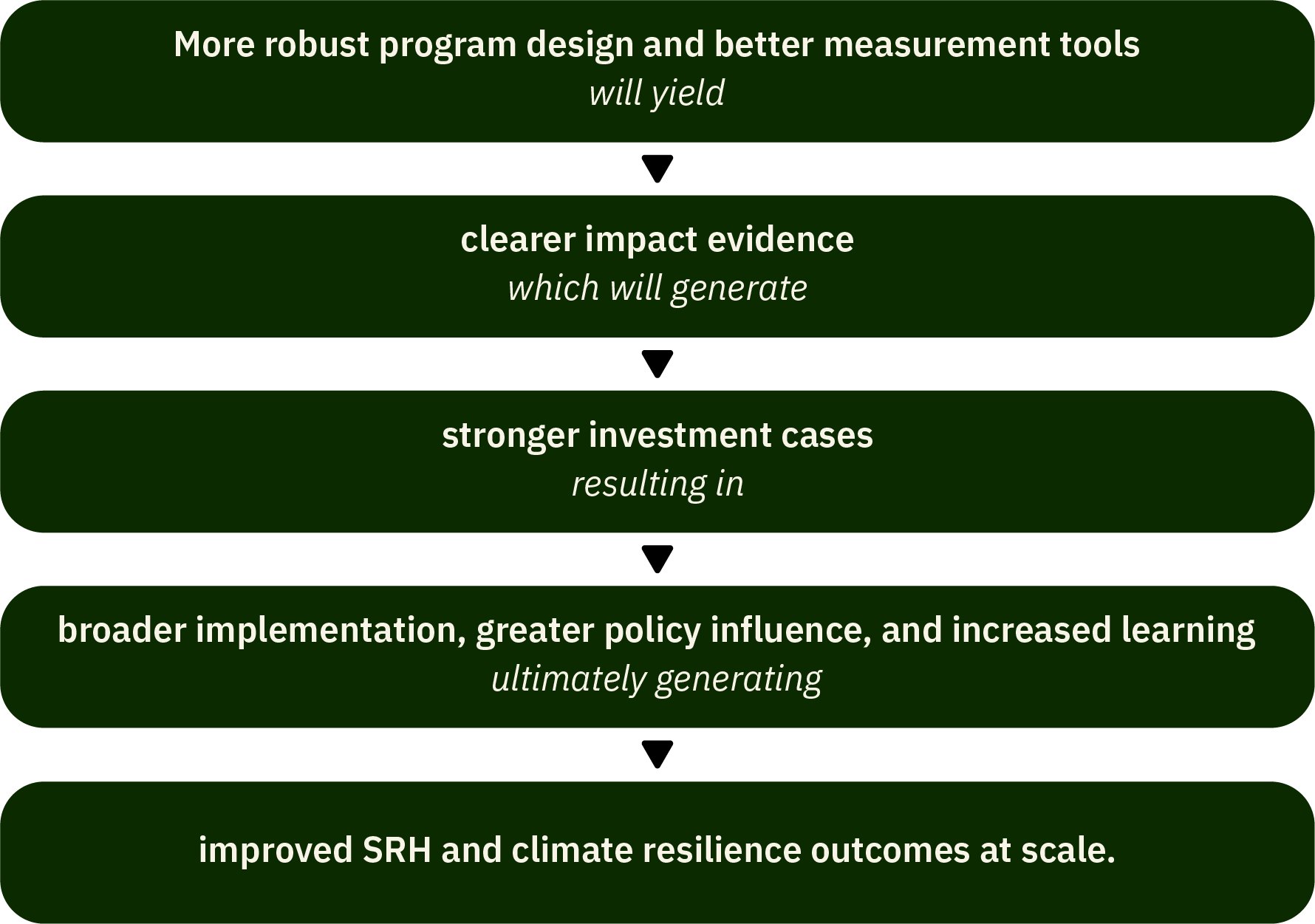
Climate-SRHR investments require robust MEL approaches.
Monitoring, Evaluation, and Learning (MEL) refers to the process of 1) continuously collecting data on intervention performance (monitoring), 2) systematically assessing the merit or significance of an intervention after its completion (evaluation), and 3) reflecting on information gathered to continuously improve interventions in an evidence-based manner (learning).
Without a robust MEL framework, there is no way to know if projects are being delivered as planned, nor is there any systematic way to determine whether a project is effective. Without structured strategies for learning on an ongoing basis, projects may inadvertently cause harm to beneficiaries or miss crucial opportunities for improvement.
MEL frameworks also allow donors and implementers to consider their impact across multiple projects, geographies, and timescales, strengthening their collective capacity for advocacy and measuring progress towards shared goals.
Climate-SRHR MEL: What’s Needed to Begin
MEL isn’t just something that happens at the end of a project: it’s an iterative process that should be woven in from the early stages of project design. This is true whether you are a funder supporting investments in climate-SRHR programming or a community-based organization implementing SRHR interventions in climate-affected areas.
Before developing and implementing a MEL approach for your portfolio or project, there are several pieces of information that will enhance your ability to develop a robust MEL approach:
An assessment of climate risks in the focal region, including their connection to SRHR
A problem tree or other situational analysis exploring the drivers and consequences of the core climate-SRHR problem that you are trying to address
A clear goal or impact related to climate change and SRHR that your project or portfolio is trying to achieve
A theory of change or logframe that links proposed activities to specific and measurable outputs, outcomes, and an impact related to both climate change and SRHR, as well as any mediating factors, potential risks, and assumptions
A plan for how you will use MEL data that you gather, including goals related to accountability, evidence generation, advocacy, innovation, scale-up, and/or re-investment
An assessment of MEL resources that your organization has available, including budget, technical expertise, time, etc.
A climate risk response plan that includes strategies for monitoring and responding to climate hazards that may occur during implementation

Tool: Incorporating Climate Risks into Portfolio Strategy
Learn how to build a strategy that considers climate risks to SRHR.

Key Terms
-
Sexual and reproductive health and rights (SRHR) is at the core of this framework. Sexual and reproductive health (SRH) refers to a state of total well-being in relation to all aspects of sexuality and reproduction. All individuals have the right to make decisions about their bodies and the right to health, as well as the right to access services that support these rights. Key sexual and reproductive health services include:
- Comprehensive sexuality education and information on sexual and reproductive health
- Prevention, detection, and management of gender-based violence, coercion, and other harmful practices such as female genital mutilation/cutting and early/forced marriage
- Choice of safe and effective contraceptive methods
- Safe and effective antenatal, childbirth, and postnatal care
- Safe and effective abortion services and care
- Prevention, management, and treatment of infertility
- Prevention, detection, and treatment of sexually transmitted infections (STIs), including HIV, and other reproductive tract infections
- Prevention, detection, and treatment of reproductive cancers
-
This framework specifically focuses on what we will refer to as “climate-SRHR” projects and portfolios. For the purposes of this guidance, we define these as projects and portfolios that 1) focus on strengthening SRHR and 2) integrate some aspect of climate resilience into their design and/or delivery approach.
This framework focuses on climate-SRHR projects because dedicated resources to support MEL for these types of activities are virtually non-exist. This framework will also be useful to projects that focus on strengthening climate-related outcomes with secondary benefits for SRHR, as well as projects that work on addressing climate- and SRHR-related outcomes in parallel.
-
There are different approaches to taking action to address climate change: climate mitigation focuses on human interventions that reduce emissions or enhance the sinks of greenhouse gases, whereas climate adaptation refers to the process of adjusting to actual or expected climate and its effects in order to moderate harm or take advantage of beneficial opportunities. Climate resilience, on the other hand, refers to the capacity of interconnected systems to cope with a hazardous event, trend, or disturbance while maintaining their essential function, identity, and structure. The concept of climate resilience can be applied to multiple levels, including individuals, households, communities, health facilities, health systems, livelihoods and economies, governments, and more - and its specific definition may vary based on the needs and values of any given group or system being evaluated. While there are ways to integrate climate mitigation into SRHR projects - such as through reducing emissions in the production and distribution of SRH commodities or through transitioning to renewable energy at SRH service delivery sites - most projects that integrate climate change as part of achieving their SRHR goals do so with an adaptation focus. Therefore, our focus in this guide is specifically oriented towards SRHR projects which integrate climate adaptation approaches as a means of strengthening climate resilience.
-
Climate risk refers to the potential for adverse consequences to human or ecological systems, and can arise from both the impacts of climate change as well as human responses to climate change. Risk is the product of the dynamic interaction between the hazard(s) (natural or human-induced events which may cause harm to humans, property, or the environment), vulnerability (propensity or predisposition to be adversely affected, including sensitivity to harm and lack of capacity to cope), exposure (the presence of people, livelihoods, ecosystems, infrastructure, resources, etc. in places that could be adversely affected), and response (actions taken address climate change risks including actual progress towards their intended objectives as well as trade-offs with or negative side-effects on other societal objectives).